News
From Vision to Reality: A Decade of National Clinical Interoperability
How Uruguay built a national clinical interoperability platform, and the lessons K2BHealth presented at HIMSS 2026.
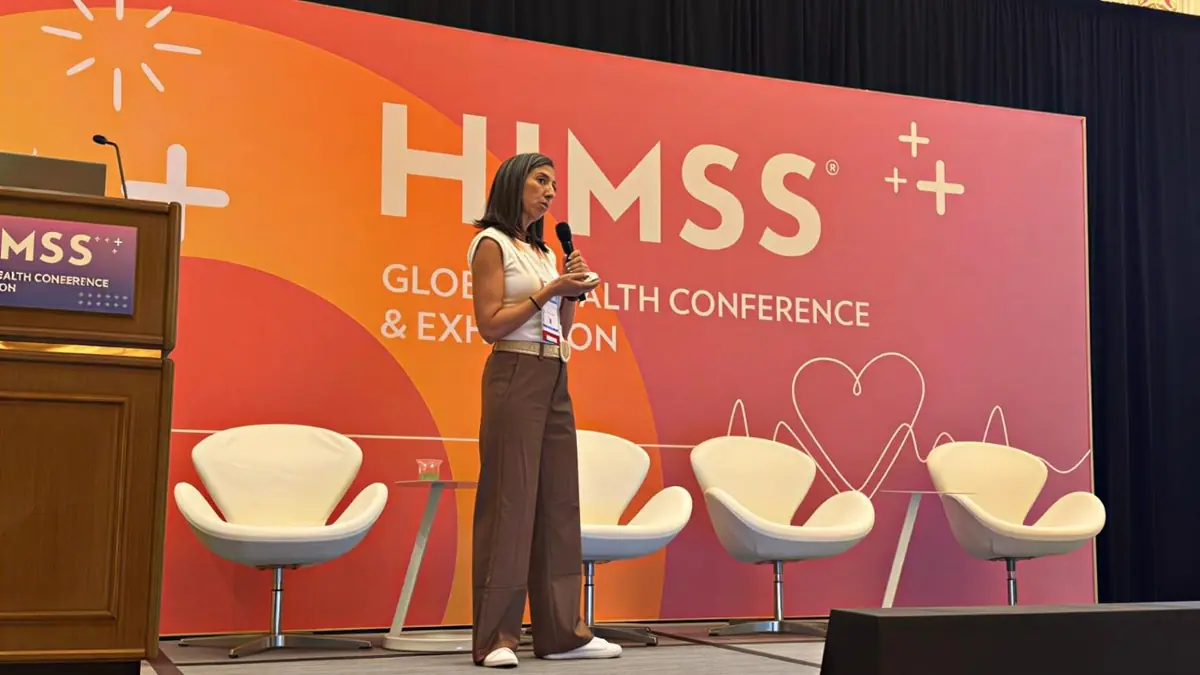
By Marcela Corbo, Director of K2BHealth
Last March I had the honour of presenting at HIMSS 2026 the case of Uruguay’s National Electronic Health Record: a project that has spent more than a decade transforming the way Uruguayans access, manage and share their health information.
It was a chance to reflect on a road that was not always easy, but that left invaluable lessons for any country or health system aiming to build an interoperability platform at national scale.
The starting point: a small country with large digital ambitions
Uruguay has just over 3.5 million inhabitants and a digital infrastructure that surprises more than a few people. Ninety per cent of the population has internet access at home or on a mobile phone, and since 2007 the Ceibal Plan has guaranteed every child in a public school their own computer. That is no small detail: digital culture was embedded in society before the health system began its own transformation.
That same year, 2007, saw the creation of the National Integrated Health System (SNIS), aimed at strengthening primary care, guaranteeing universal access to health services and articulating the public and private networks across the whole country.
Where the project came from: political leadership and strategic vision
In 2012, AGESIC — Uruguay’s e-government agency — created Salud.Uy, focused on improving access to clinical information and promoting interoperability between providers.
One factor cannot be glossed over: the president of Uruguay at the time was an oncologist by training. That clinical perspective at the political helm proved decisive. In 2013 the national oncology health record was born, as a pilot for what a national registry might become. That first step made it possible to learn about interoperability standards, to identify the technology gaps between providers, and to design an adoption plan based on the reality of the system rather than on an ideal scenario.
A phased plan: the key to sustained success
One of the most important lessons of the project was precisely this: do not try to do everything at once.
The adoption plan was structured in five major stages:
- National Person Registry — the foundation of everything: identifying each individual correctly.
- Level 1 CDAs — starting to generate standardised clinical documents, supporting providers through implementation.
- Clinical event registration — progressive capture of information on the platform.
- Information retrieval — the platform begins to give value back: querying and accessing clinical data.
- Minimum data sets — information structured by level of care and by specialty.
Throughout the process, teams specialising in cybersecurity and change management worked across all stages to secure real adoption of the solution.
The patient at the centre: the birth of Mi HCE
In 2019, with the platform running and providers integrated, Uruguay took a step that defines the true north of the project: the launch of Mi HCE, a portal that lets patients access all their clinical information. That evolution reflects the value of having electronic health record software able to consolidate data, enable secure access to information and strengthen the patient’s active role in their own care.
The decision was not incidental. It was a statement of principle: the patient owns their health information. Accessibility and transparency are not an add-on to the system; they are its reason for being.
The ultimate test: the COVID-19 pandemic
A few weeks after Mi HCE launched, the world changed. The COVID-19 pandemic arrived as a stress test for every health system on earth, and Uruguay was no exception.
But the platform was ready.
With providers integrated and patients able to reach their own information, Uruguay was able to deploy an application for case follow-up, teleconsultation, access to PCR results and proximity-based contact tracing very quickly. The response was fast, coordinated and data-driven.
The pandemic made clear something we already knew, but that was demonstrated beyond argument: a national interoperability platform is not just a communication channel between providers. It is a centralised data repository that enables population monitoring and real-time decision-making.
Lessons learned: what we take away after a decade
After more than ten years on this project, the lessons that resonate most are these:
- Constant, participatory communication with providers was essential. Deploying technology is not enough; you have to sustain the relationship, listen to concerns and support people through the difficulties.
- Short-term goals prevent people from losing heart. A clear plan with achievable milestones keeps every stakeholder engaged and makes it possible to show concrete results.
- Change management is not a complement; it is part of the core of the project. A dedicated team for communication and support made the difference.
- An empowered patient is the best indicator of success. When a person can reach their own medical record, the system delivers on its deepest promise.
A closing thought
Presenting this case at HIMSS 2026 was a reminder that digital transformation projects in healthcare are not built overnight. They are built with strategic vision, with the patience to respect each stakeholder’s pace, with the humility to learn along the way, and with the conviction that clinical information, well managed, saves lives. Along that road, innovation applied to the healthcare sector turns lessons, technical capability and institutional needs into concrete, sustainable, people-centred solutions.
At K2BHealth we continue to walk this road, putting our 25 years of experience in the health sector at the service of systems pursuing the same horizon: care that is more connected, more equitable and more centred on people.
Want to know more about how K2BHealth can support your organisation on interoperability and Electronic Health Record projects? Get in touch.