HISThe inside
All clinical operations: outpatient, emergency, inpatient, operating theatre and cross-cutting services.

Connect

Make integration easier and ensure communication between the internal and external clinical systems of your healthcare institution.
Our Interoperability Platform centralises information in a single place and enables uniform communication through international standards.
Our solution also lets institutions connect with other organisations, both nationally and internationally.
With information centralised and available in real time, data is easily accessible for well-founded decisions, improving patient care, hospital management and strategic decision-making.
It is the layer that lets the systems of an institution — and of other institutions — exchange clinical and administrative information in a common language: standards such as HL7 FHIR and HL7 CDA. Dandelion is that layer: it receives data from every system, standardises it, stores it in a single health record and makes it available to whoever needs it, in real time and with access control.
A single health record at the centre; every piece plays its role around it.
Clinical and administrative teams
All clinical operations: outpatient, emergency, inpatient, operating theatre and cross-cutting services.
Patients and their families
Self-service, clinical information and telemedicine, on the same record.
read and write · HL7 FHIR
Base layer · interoperability
Interoperability and a single health record — where everything lives and connects.
integration adapters
Designed for comprehensive interoperability, real-time data and global standards, and as a foundation for innovating with AI.
Stores and exchanges clinical and administrative resources securely.
Unique identification of people; prevents duplicate patients.
Holds all of the patient's clinical information, standardised.
A cross-cutting, chronological view of the record, whatever its source.
Attaches non-standard or scanned paper documents to the EHR.
Standardises clinical data in SNOMED CT.
Authentication, authorisation and users for the whole solution.
Topic-based notifications between components, in real time.
Integrate ERP, RIS, LIS and external networks with the platform.
We start with a thorough assessment of the organisation's infrastructure and needs, to understand its level of maturity and create a personalised digital roadmap.
We select the key information from your clinical systems and transform it according to international standards such as HL7 FHIR and HL7 CDA. This process ensures efficient, secure communication between the different systems.
We optimise the management of clinical data with a real-time viewer and BI tools for in-depth analysis, with the ability to integrate custom AI assistants. We also deliver an improved user experience through portals and apps for patients.
We drive the digital maturity of your healthcare institution, boosting its competitiveness and its position in the market.
Communication and information exchange are key to raising the quality of medical care.

International data standardisation (HL7 CDA, HL7 FHIR).

Immediate access to all the information.

Secure, centralised storage of clinical information.

Business intelligence for decision-making.

Connection with every clinical and administrative system.

Flexibility, adaptability and compatibility.
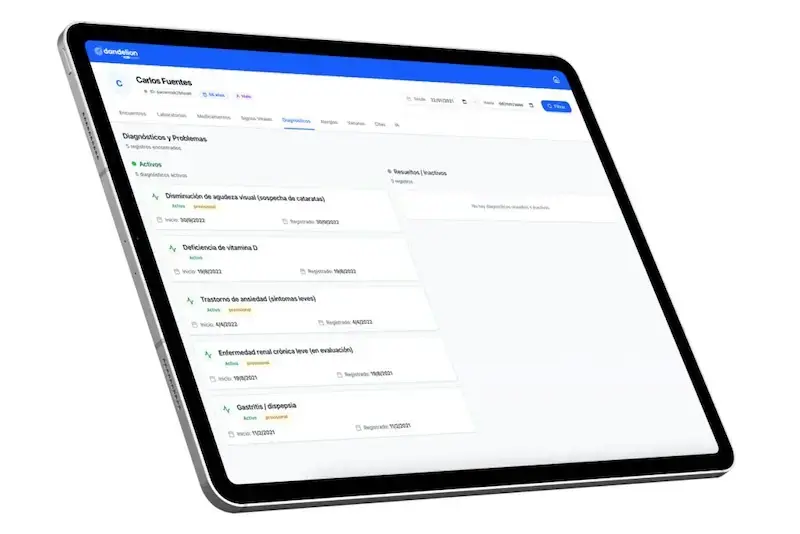
Our interoperability platform includes a Clinical Information Viewer for accessing and displaying clinical documents (HL7 CDA) and clinical and administrative resources (HL7 FHIR).

The main goal of the viewer is to provide a uniform, accessible experience for technicians and physicians at every level of care.

Professionals can access the patient's complete medical history and use advanced data analysis tools to make informed decisions and improve the quality of care.
Interoperability improves patient care by providing fast, accurate access to patient data, which translates into more precise and timely care. It not only lets physicians make informed decisions based on the patient's complete history, but also reduces the likelihood of medical errors, such as prescribing the wrong drug or repeating tests, improving patient safety and preventing complications.

Interoperability simplifies the administration of clinical data, cutting the time and resources needed to access and share information. That saves time for healthcare professionals and patients alike.

The ability to exchange information effectively between different healthcare providers ensures optimal continuity of care. Patients receive continuous, coordinated care even when they visit several healthcare institutions.

Interoperability in healthcare also supports medical research and data analysis. The availability of large clinical databases simplifies research, which can lead to advances in the treatment of disease and to better health overall.

Why K2BHealth
Through technology we help improve patient care at every level: medical, care delivery and administrative.
Dandelion is the platform on which the providers of Uruguay's National Integrated Health System share their users' clinical information. Read the case study.
All exchange happens in HL7 FHIR and HL7 CDA, with SNOMED CT terminology: information that enters Dandelion can flow out to any system that speaks the standard, today or ten years from now.
We support the organisation and its system vendors so they can connect to the platform quickly and securely, with technical and functional support afterwards, as SaaS or on-premises.
Request advice by filling in the form below. Please make sure to include all your details so we can get back to you promptly.
Implementation time depends on the number of systems to be integrated, with an average of one month per system.
The involvement of the organisation and its system vendors is essential to achieve a high-quality interoperability ecosystem.
We support the organisation and its vendors so that they can connect to the platform quickly and securely.
Technical and functional support is included after the platform goes live, with a choice between SaaS and on-premises delivery.
Centralising information and access to it makes managing and controlling who can see what much simpler.