Digital transformation
AI in healthcare: how can it give doctors time back?
AI in healthcare eases the documentation burden and helps analyse clinical data. What does it take to improve care? Read the article.
 Martín Spangenberg
3 min read
TL;DR
- The Electronic Health Record (EHR) improved the availability of information, but it also increased documentation tasks.
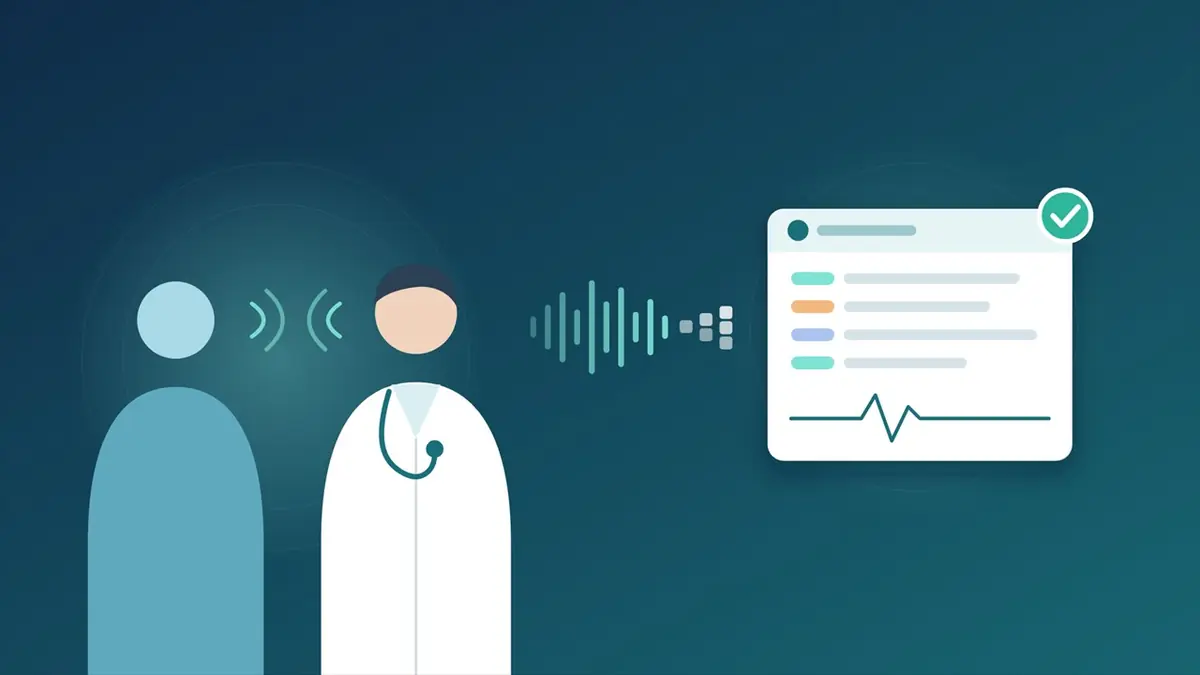
- AI can generate draft clinical notes from a consultation, always subject to professional review.
- Data analysis can help identify signals that matter for patient care and safety.
- Achieving those benefits requires quality data, interoperability and clinical oversight.
The paradox of AI in healthcare: how technology can humanise medicine
For years, the conversation was shaped by the same fear: will technology end up dehumanising medicine? Will we have doctors looking at screens instead of patients?
The evidence we are seeing today says the opposite. And that is where the paradox lies: the very technology that many feared as a threat to the doctor-patient relationship is, in fact, the one that can give that relationship back its time, its clinical attention and its meaning.
There are two very specific reasons for this.
AI gives doctors back the time we took from them over 20 years
Over the last two decades we built Electronic Health Records to solve a very real problem: making patient information available wherever the patient happened to be, and thereby guaranteeing continuity of care. It worked. But to achieve it, we asked something of doctors: that, on top of seeing patients, they structure the data. Fields, codes, forms, drop-down lists. A doctor understands free text by reading it; a system does not.
The result is familiar to anyone who has set foot in a consulting room: the doctor turned into the typist and coder of their own clinical record, filling in fields quickly to be able to move on, often at the expense of data quality.
Today, generative AI reverses that twenty-year logic. The doctor speaks, describes and treats patients as they always have, with their own language and their own way of reasoning clinically, and it is the system that structures itself in the background. It is not the human adapting to the machine: it is the machine adapting to the human. That recovered time is not an efficiency detail; it is time that goes straight back to the patient.
AI draws on 20 years of clinical records to anticipate what lies ahead
The second change is just as profound, although it is talked about less. Over the years we accumulated millions of clinical records with free text, incomplete fields and information scattered across institutions and formats. In practice, that volume was almost impossible to exploit. Today there are models capable of reading the text accumulated over decades and finding structure, meaning and patterns in it.
To understand why this matters, a real case is worth looking at.
The Vioxx case. In 1999, Merck launched Vioxx, an anti-inflammatory drug that was eventually taken by some 80 million people in the United States and that passed the most rigorous clinical trials required by regulation. Five years later it was withdrawn from the market: it doubled cardiovascular risk. The FDA conservatively estimated around 38,000 excess deaths from heart attacks or cardiac problems.
The Vioxx case was not a lack of data. The adverse event reports were there, scattered, piling up year after year. It was a lack of capacity to read them in time. That is exactly what AI can do today: cross-reference adverse event reports, scientific literature and clinical records in real time, and recalculate risk continuously, without waiting for years of manual accumulation to realise what was already happening. The same capability applies to detecting diagnostic and treatment patterns in information that, while scattered, was invisible even to the most rigorous systems.
Uruguay also has an asset that is rare at this moment: through AGESIC’s Salud.uy programme, the National Electronic Health Record (HCEN) already exceeds 300 million records. Many countries are still fighting the battle to digitalise; Uruguay has already fought it. The challenge now is to finally have the technology to make real use of that volume.
The conclusion: a paradigm shift
AI did not come to speed up the consultation. It came to give time back to what the consultation should always have been: one person listening to another, building a relationship. That recovered time is not measured in patients seen per hour; it is measured in quality of care.
That is why we speak of a paradox: the technology that many feared would be the end of human medicine turns out, in practice, to be the one that rescues it. AI does not replace clinical judgement: it empowers it, by providing better information, more time and greater clarity.